
The story of the Tarascon Brothers, Louis and John, began as one of dreams, entrepreneurship, and commercial success. It ended in failure, financial ruin, and personal tragedy.
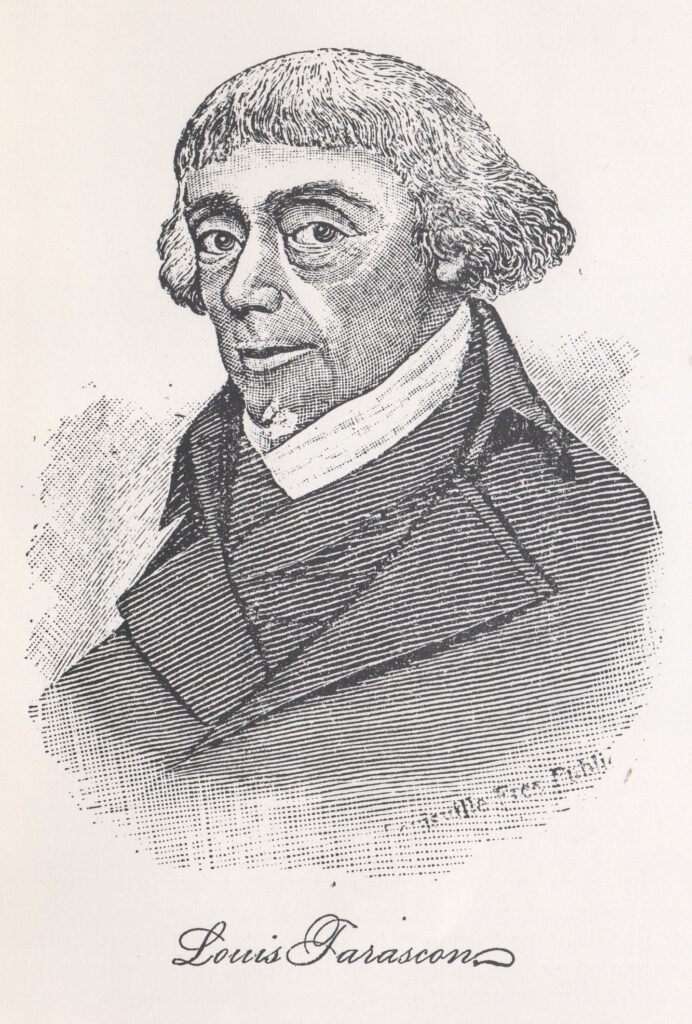
John Antoine Tarascon came to America in 1794 to escape The French Revolution. Older brother Louis Anastese Tarascon arrived in 1797 to help. They brought with them boat building skills, a desire to create, and an optimistic outlook on the world influenced by Voltaire and the French Enlightenment.
They landed in Philadelphia and began a business importing French silks and building seagoing vessels. They were interested in the possibility of sending their boats down the Ohio River to New Orleans to ship farm produce directly to Europe. In 1799 they sent their clerk, Jacque Berthoud, who they met on their trip to America, down the Ohio and Mississippi Rivers to explore the possibilities of their enterprise. Upon his return he gave the brothers a favorable report. They bought land in Pittsburgh, moved there and began building ships. Their shipyard was a commercial success and turned out to be the largest in Pittsburgh at the time.
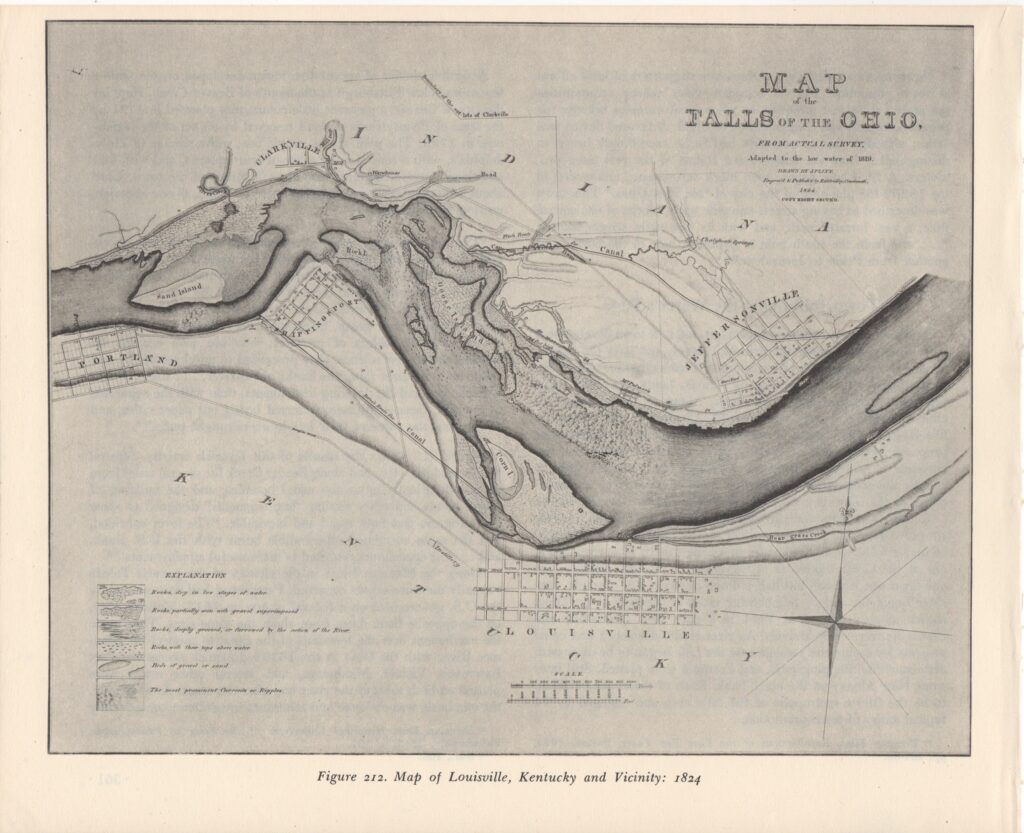
Their idea had one main obstacle – The Falls of the Ohio. It was a series of rapids which could only be navigated during very high water. All river traffic had to stop at the Falls, unload their cargo and portage it over land around the Falls. In 1803, one of their vessels wrecked on the rocks. Losing everything led them to realize that building a shipyard needed to be below the Falls. They bought 45 acres of what had been John Campbell’s land deeded him for service in the French and Indian Wars.
In 1806, Shippingport, Kentucky was born. Now the brothers set out to establish a town, a shipyard, a rope walk for making rope, a wharf, and warehouses for storage. They attracted other French families escaping the French Revolution. Soon a thriving French community was competing with Louisville as a vital Ohio River port.

From 1810 until 1820 the population increased from 100 people the over 500. The road between Louisville and Shippingport was filled with offloaded cargo from flatboats and keelboats from above the Falls.
In 1811, the first steamboat arrived ushering in a revolution in river travel. In what took a keelboat from New Orleans 3 to 4 months, the steamboat could do in 25 days. A commercial explosion was on. A new era had dawned.
The War of 1812 put an end to the Tarascon’s boat building dream when President Thomas Jefferson stopped all ocean-going travel by American ships. He did not want our merchant ships to get into problems with the British.
Their port however continued to be successful as evidenced by the following 1816 advertisement.
“Announcing the arrival of new merchandise and for sale by John A. Tarascon at Shippingport, Ky. 1200 Spanish hides, 89 crates Queensware, 30 barrels of mackerel, shad and herring, 4 barrels of Glauber salt. Other items mentioned were coffee, sugar in barrels, copper in pigs, rum and gin in barrels, Juanita iron, coal, leather, and gun powder”.
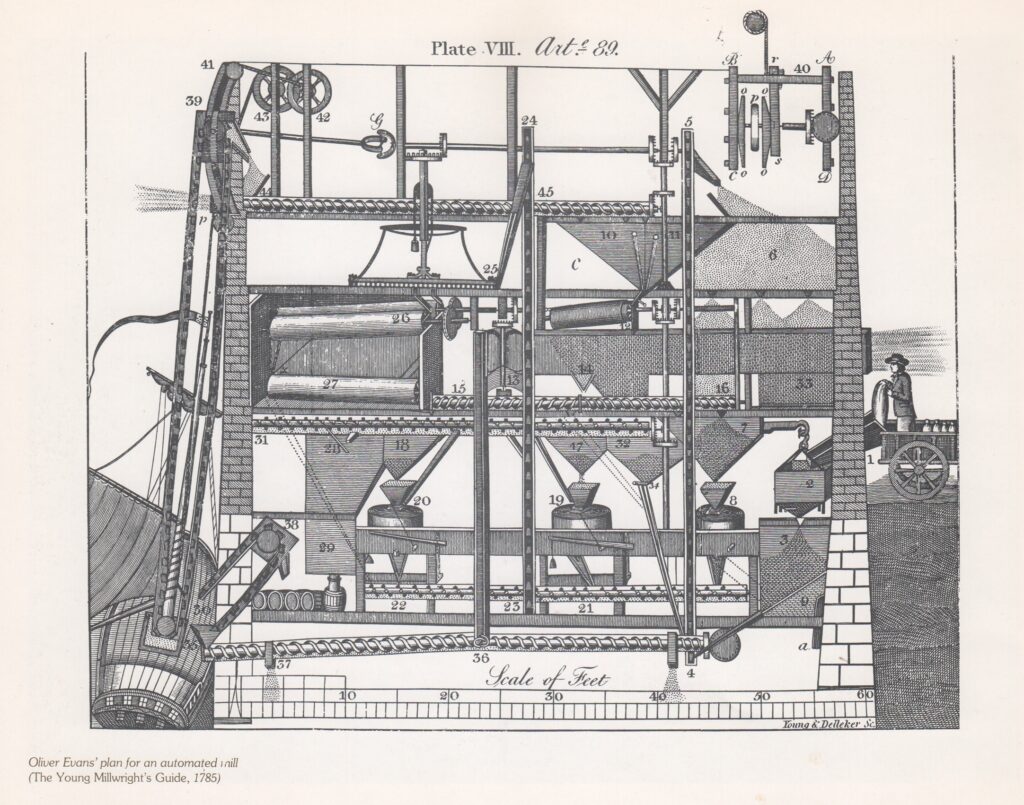
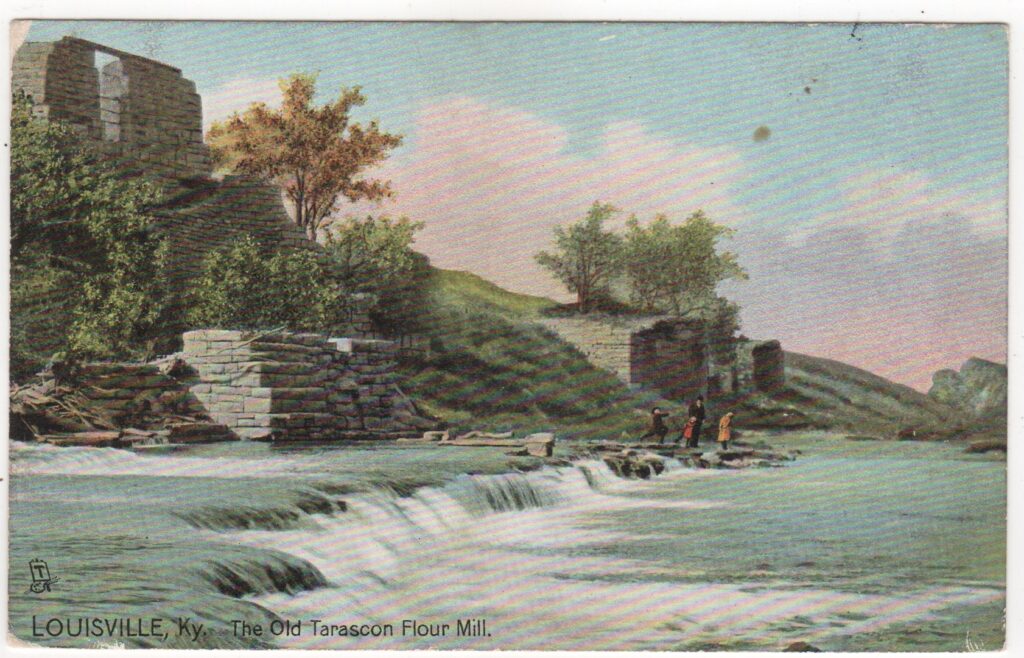
In 1817, a six-story flour and grain mill at the cost of $150,000 was begun. It was completed in 1819 symbolizing Shippingport’s industrial success. The mill incorporated the most advanced milling technology of the day. It harnessed the water of the Ohio River at the Falls to grind corn and other grains. It used Oliver Evans design. He was the leading machine inventor in America. It incorporated elevators, belt conveyors, screws, gravity, and other material handling devices. You could drive your wagon under the arch and unload your wagon into a hopper. It would weigh your load at the rate of 75 bushels every ten minutes. It could grind 500 barrels per day.
Ironically, the boom in Steamboat traffic was the beginning of the end for the Tarascon’s dream in Shippingport. The city of Portland was a little farther downstream and provided a better anchorage for the new boats. Business began to slow. Another factor was the completion of the Louisville and Portland Turnpike in 1818. It provided a more direct land route around the Falls for cargo dropped off in Louisville. The economic decline was also precipitated by the great Tarascon Mill being inactive for as much as 6 months a year due to low water on the Ohio River. By 1825, John Tarascon’s finances were in very bad shape. He saw no way out and committed suicide. He left the mill to his children to be managed by his brother in their behalf. The final blow was the completion of the Louisville and Portland Canal in 1830. It cut off Shippingport altogether and made it an island. The mill was brought back to life by its creditors by grinding the limestone excavated from the canal and making the cement to be used in its construction.
In 1832, Mother Nature did her part with a great flood which caused most of the French families that were left to relocate to Portland where they played an important role in the development of that city.
The mill continued to grind limestone to make concrete until in 1892 when a fire devasted it and left it in ruins. Today, The Louisville Gas and Electric Company’s hydroelectric plant stands where the mill once stood supplying 7% of Louisville’s electricity.
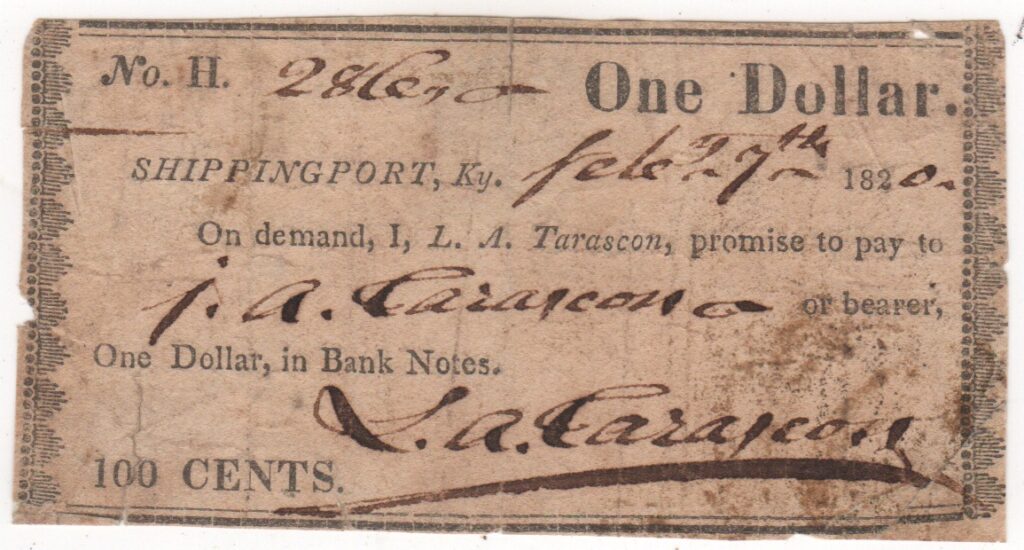
Information on Obsolete Currency issued by Louis A. Tarascon:
The one-dollar obsolete currency note issued and signed by Louis A. Tarascon promises to pay his brother, John A. Tarascon or bearer one dollar in bank notes. It is dated February 7, 1820, from Shippingport, Kentucky. The Hughes reference book on Kentucky Notes and Script lists it as #770 $1.00 R-7(1 to 5 known) No. H 286 This note was issued at the height of Shippingport and the Tarascon Brothers success.
Bibliography
- Kentucky Obsolete Notes and Script by Earl Hughes Society of Paper Money Collectors 1998
- The Encyclopedia of Louisville Edited by John Kleber University Press of Kentucky 2001
- Two Hundred Years at the Falls of the Ohio A History of Louisville and Jefferson County by George Yater The Heritage Corporation 1979
- The Tarascon Mill Portland Museum/Roosevelt Community School by George Yater National Endowment of the Humanities and Kentucky Humanities Council 1981
- The Falls, A Stopping Place A Starting Point Portland Museum by Judy and Bill Munro-Leighton National Endowment of the Humanities 1979