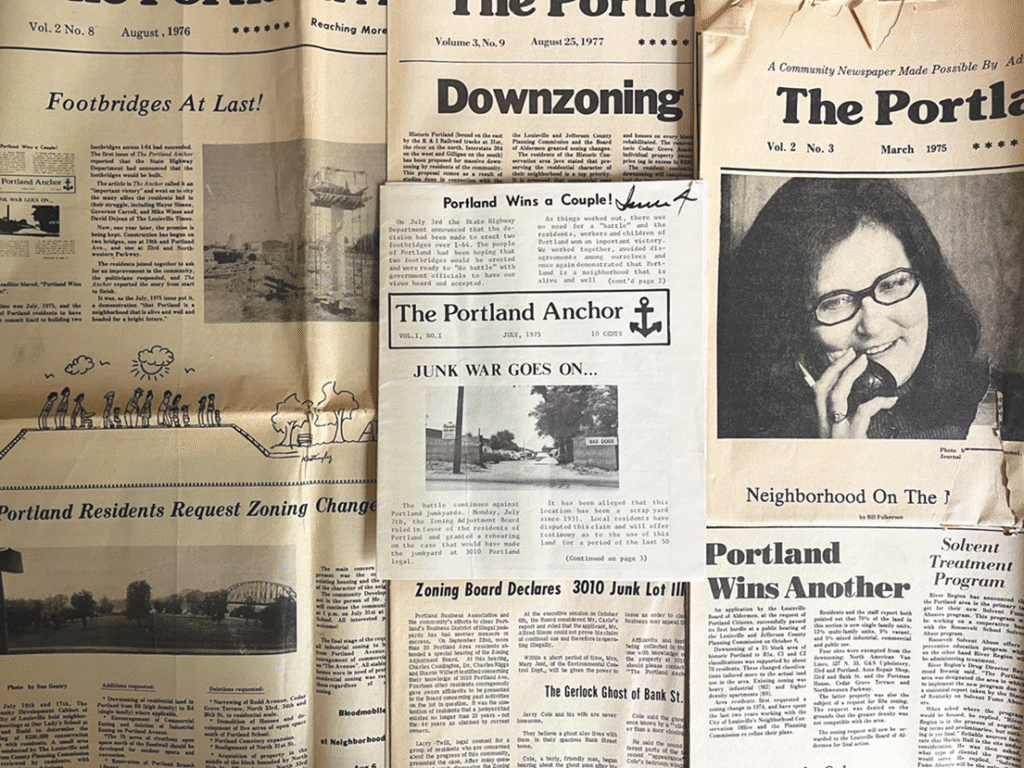

Contrary to the massive impact it would have, the Portland Anchor’s fist issue in July 1975 is also its physically smallest at only 7″ x 8.5″. This miniature size put a premium on frontpage news, with the paper’s two debut headlines reading: “Portland Wins a Couple!” and “JUNK WAR GOES ON…”, which earned the cover photo with a shot of what then was Marshall’s Auto Parts at 3010 Portland Ave. Headline one’s couple of wins refers to the State Highway Department’s commitment to construct a pair of footbridges over I-64 here in Portland, an effort still proudly recalled by the Anchor’s remaining founders and described at the time as the neighborhood having “worked together, avoided disagreements among ourselves and once again demonstrated that Portland is a neighborhood that is alive and well.” Construction had already begun by August 1976, with that month’s headline “Footbridges At Last!” celebrating that “the promise is being kept,” a truth to this day with another couple of wins, the bridges’ reconstruction, reported in February 2025’s Anchor.
Returning to volume one number one though, this self-described “important victory” might have been editorially outmatched by the all-caps JUNK WAR, a story that on its garbage-focused surface may appear less-than flattering for the neighborhood, but upon investigation reveals an even more successful community initiative. As the headline alludes, this fight with Marshall’s Auto Parts was but one battle in a greater war, one against Louisville’s inhospitable zoning of Portland and the lacking enforcement of what little protections the neighborhood had. Illegal junkyards started to encroach onto Portland Avenue as early as the 1950s and had by the 1970s overstayed their welcome with the area’s commercial and residential properties. Marshall’s when reported to Louisville’s Zoning Adjustment Board argued their yard at 3010 had existed since the 1930s, stubbornly grandfathering it into legality, but seventeen Portlanders testified otherwise. Those residents were victorious, and their win was reported in the Anchor three issues later alongside another promising headline: “JUNK PICK-UP PRECEDS MAYOR’S VISIT.”

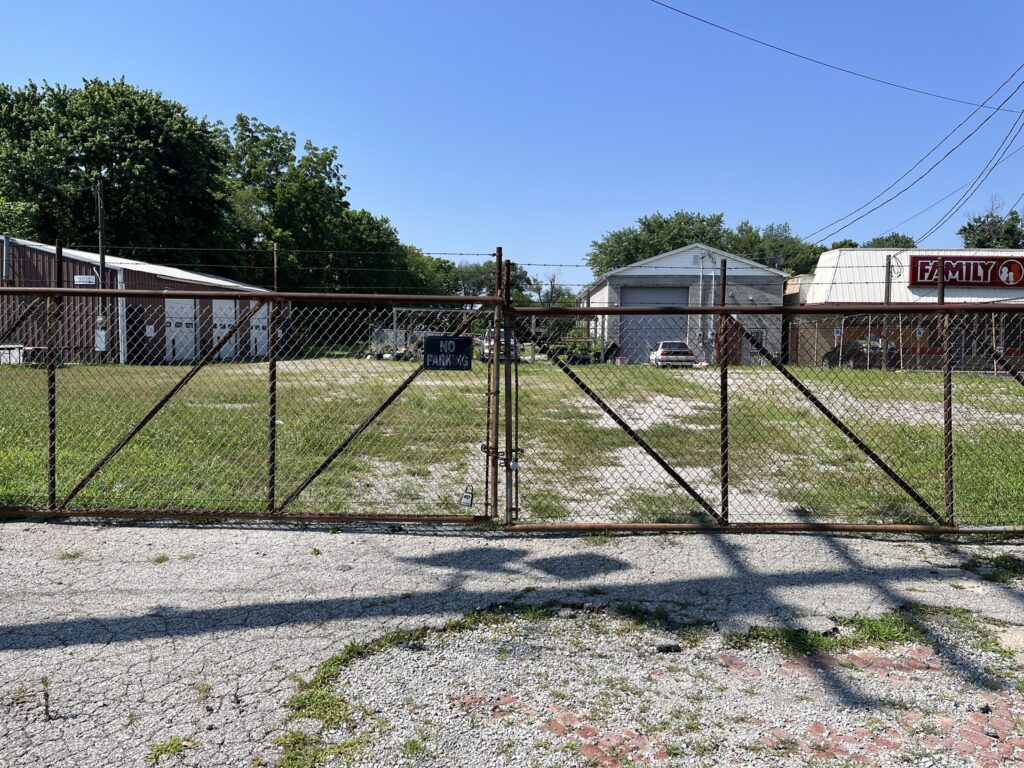
In the shadow of the footbridges’ construction, August 1976 saw the Junk Wars find a new frontier with the headline “Portland Residents Request Zoning Changes.” Junkyards were but one of Historic Portland’s environmental hazards, with everywhere west of the K&I railroad tracks, east of I-264, and north of Gilligan St. zoned for heavy industry and slowly losing its “residential character.” In a year’s time bullet-point requests developed into a downzoned map of the whole neighborhood “protect[ing] the investment of residents in the area” and “better relat[ing] zoning regulations to the existing land use.” The plan was set for a vote in November, reported under the headline “Portland Wins Another,” and in February 1978 “without fanfare or drumroll” approved unanimously by the Louisville Board of Aldermen. Headlined “A New Beginning,” the Junk War after “over three years of planning, meetings, public hearings, lobbying and negotiating quietly came to an end.” The lots at 3010 Portland Ave. that fired the first shot are today zoned for commercial use (C-1) and on the market for $290,000.
This victory was undeniably a community effort, but the name Sharon Wilbert follows the Junk War from beginning to end throughout the pages of the Anchor. Wilbert was a founding member of the Anchor’s editorial board, a sixth-generation Portlander, and much more according to February 1977’s issue: “the Chairperson of the Portland Festival Committee, Secretary in the Portland Business Association, Board member in the Portland Development Organization, member of the Portland Community Development Task Force, and Vice Chairman and Secretary of the Neighborhood House Board of Directors.” Wilbert announced her candidacy for 11th Ward Alderman that same month, successfully taking her experience as a neighborhood activist into the campaigning arena and winning office that November. She was one of those unanimous votes for rezoning in February 1978 and continued to dutifully represent Portland’s “new spirit of pride and determination” on the Board well into the 1980s.