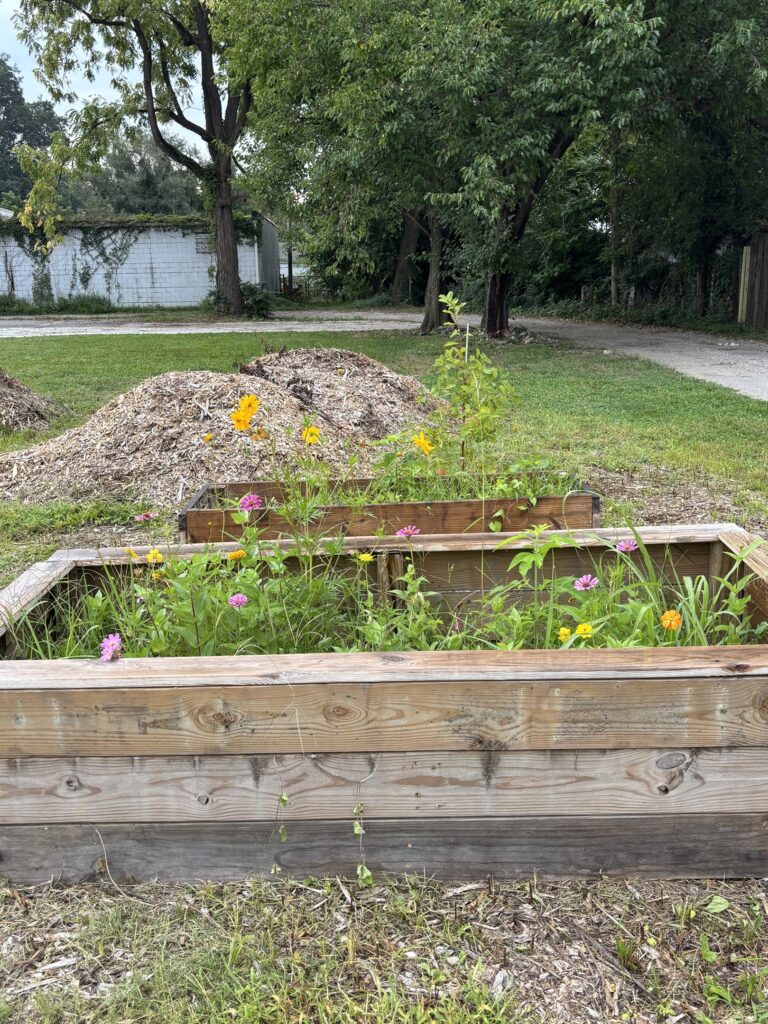
What I noticed first was the scar. It was early Monday morning and I was engaged in my usual pre-work ritual: moseying over to check on the tangled lot of pollinators and fruit trees I’m trying to raise from what was once ash and rubble along 26th Street. It’s been a process. The whole experience has shone light on so many areas of my own ignorance, and have you ever tried consistently weeding in this climate? In any case, there in the garden was a rutted swoosh. A big comma carved in mulch. A comet-streak of earth that trailed off at the edge of the gravel alley. It was only after that I noticed the trees. One cherry and one peach, each broken at shin-level. The cherry trunk was a little more than broomstick-thick and completely severed from its base, lying limply several feet away. The peach tree was closer to the girth of a finger and holding on for dear life by a strip of stubborn bark. The cardinal flowers and blue stars planted around them were erased altogether, pulled under in the tow of the spinning tire’s wake.
I felt a little sad and a little mad. Who had done this, and why? Had it been intentional? An accident? Was it the result of reckless indifference or pre-meditated vandalism? I inspected the scene of the crime like prime Columbo. The clues were there but ultimately inconclusive, and in any case the damage had been done. The next feeling was a familiar one: the sensation of having a good intention thwarted for no good reason at all, the disappointment in seeing many hours of thoughtful work undone in a few thoughtless seconds.
On its own, this anecdote isn’t worthy of a piece in this fine neighborhood newspaper. The flowers and trees can be replanted, and l hope to. What’s more important are the fundamental questions it stirs up for me: “What kind of a neighborhood do we want to live in?”, “What is our relationship with nature and, dare I say, beauty?”, and “What does it mean, at this late hour, to live at harmony with one another and the planet?” If that all sounds a little heady for a story about someone peeling out in your private garden over the weekend, please bear with me. As a new member of the PNI Executive Board, I’ve tasked myself with serving as our local tree advocate. I’ve always loved trees, and in recent years I’ve learned about how important they are in urban environments. The many roles we know they play: shade-provider, flood-preventer, air purifier, public safety-increaser, noise-buffer, bird waystation/home, etc. will only become more necessary in the years to come. Every environmental study expects the Ohio River Valley to be hotter and wetter as the century unspools, and trees are one of the few interventions that can prepare us for both, a silver bullet for our shared future’s climate challenges.
And did I mention beauty? If we all take a moment to reflect on our favorite places both in our fair city and beyond, I’m willing to wager that tree canopy plays a role in that choice. Trees change the aesthetic of urban landscapes. Our very own Northwestern Parkway has been a shining example of this for decades, and as the sentinel oaks that Olmsted planted in the 1890s have slowly come down, either from age or disease, the character of that historic corridor has subtly shifted.
What I think we have to do next involves three P’s: Preserve, Plant, and Prize. The first two, while not easy, are fairly straightforward. We can hire arborists to help save the elder trees still among us and find grant funds and volunteers to put saplings in the ground. We know how to do those things, and we should. But until we all agree that trees are to be prized, and have a shared understanding of their implicit and explicit value, my fear is that those efforts may ultimately be in vain. Can we love something we don’t know? Can we actually prize a thing we don’t appreciate in its fullness? I think the answer is no, and Wendell Berry agrees. In his now-famous Jefferson Lecture “It All Turns On Affection”, Berry not only centers affection as essential to proper stewardship and care of any place, he also harkens back to his mentor Wallace Stegner’s notion of “boomers” and “stickers”. In this nomenclature, “boomers” refers not to a generational grouping but to those who “pillage and run.” Extractors, in other words. On the other hand, “stickers” are defined as “those who settle, and love the life they have made and the place they have made it in.” How familiar these themes are here in our West End neighborhoods.
Which brings me to my final and somewhat laterally-related point: It’s my sense that a lot of our neighborhood’s legacy residents see most newcomers, and a lot of “new” ideas, as boomers rather than stickers, and some of the pushback I’ve observed in my 11 years living of Portland Avenue has been rooted in that fundamental distrust. It’s my hope that we can rally around the restoration of Portland’s tree canopy and the revitalization of its green spaces as a cause that is mutually beneficial to all and ultimately rooted in the history of this community and in an earnest hope for its future. The utility of trees is not a new idea, it’s just one that we’ve forgotten over time. And besides, a great many of us have been stickers all along. There’s perhaps no greater testament to this fact than our desire to plant trees under whose shade we may never sit, in this case literally. I hope you’ll join us. That’s something I’d prize even more than the birdsong and lovely foliage.