
The Making of Human, too
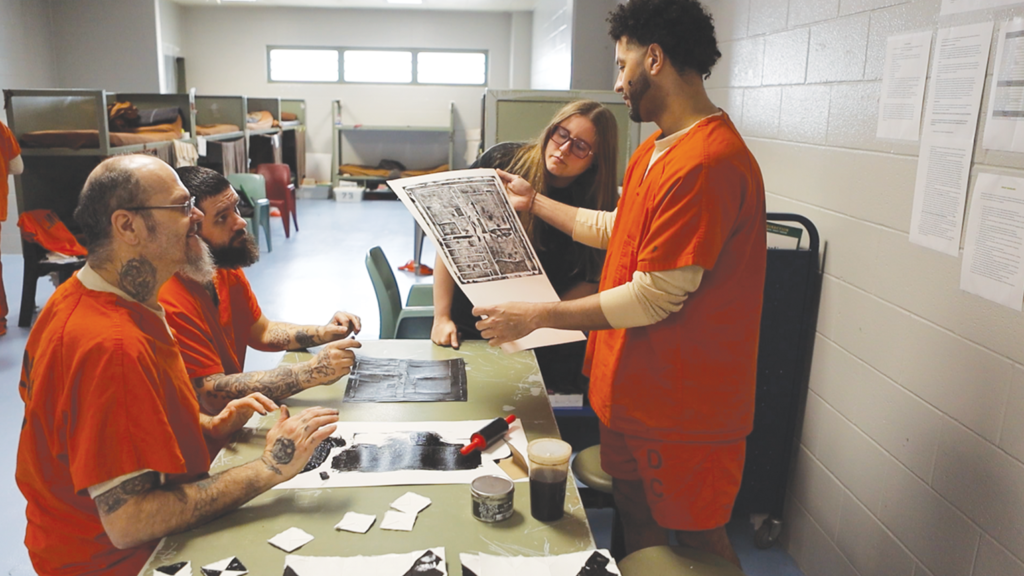
Last year, I started volunteering to teach art classes inside Louisville Metro Department of Corrections. One dorm in particular brought so much enthusiasm that we set out to collaborate on an exhibition about their experiences. This dorm was Chance 4 Change, a 90-day substance abuse recovery program.

Although we started with poetry (odes and blackout poems from old Alcoholics Anonymous and Narcotics Anonymous books), we had ongoing conversations about their everyday lives in incarceration, reconsidering what had faded into the mundane for them to then reconfigure into creative prose, like recipes for their jailhouse cookbook and witty dialogues for their book More Than Just a C.I.N.
From there, I brought adapted forms of printmaking to accompany their texts, such as relief printing foam plates, hand-printing cardstock collagraphs, stippling paint into paper stencils, monotypes with ID cards, frottage on cinder block walls, and drypoint by drawing into milk cartons.
The C4C artists then curated these written and visual artworks into pairings for our books, each of which was hand-bound in a different technique: drum leaf, piano hinge, stab-bound, lotus-folded, and explosion. Though our bookbinding primarily relied on folded and glued paper, we utilized coffee stirrers for piano hinge binding and hand-twisted paper strips cut with safety scissors into “thread” for stab binding.

Across the duration of the project, we additionally collaborated to produce two large-scale artworks from painted milk cartons, visually emulating a “weaving,” titled 12 Steps to Freedom. and a “quilt.” titled No Milk Mondays. For both, the C4C artists cleaned, disassembled, tore, painted, and glued together each carton by hand. Referencing traditional hourglass and rising sun patterns, the quilt alone was composed of 96 cartons.
Throughout our various making processes, we rallied to overcome challenges, while sharing humor and joy, as imbued into each of these artworks. By nature of their creation, these pieces document the lived experiences of these incarcerated artists through their own hands and everyday materiality.

Many thanks to Chance 4 Change coordinators Iyan Wickel and Kelsey O’Neal for their kind guidance and invaluable assistance throughout and beyond this project. Thank you to the Portland Museum for hosting this exhibition and to Louisville Metro Department of Corrections for the material and financial support that made Human, too. a reality.
Finally, thank you to C4C artists: William Baker, William Bradley, Keaton Buie, Jerry Cook, Jack Elliott, Garad Garad , John Gorman, John Johnson, Chris Hack, Brandon Harris, Josh Hester, Steven Hicks, Brandon Lewis, Christopher Lindsey, Ricky McNabb, John McNeil, Gregory Miller, Ahmed Mohamed, Shamaine Richardson, Michael Simpson, Jesse Smith, Bleick Vonbleicken, Clarence Weeks, David Wheatley, and Robert Wright.
Your appetite to learn and eagerness to create reignited my own passion for artmaking. You all were so welcoming and open, often teaching me just as much as I taught you. I am so grateful to have had the opportunity to get to know, problem-solve, and laugh with each of you. I am so proud of our work, and I hope you are, too. We did it!

Human, too. is free and open to the public 12:00-5:00 Wednesday-Friday and 12:00-4:00 Saturday at the Portland Museum until August 29, 2026.